 Volcano
Research
Volcano
Research Plate
Tectonics
Plate
Tectonics The
Solar System
The
Solar System Galaxies
 Physical
Science
Physical
Science Rocks
Rocks The
Timeline of Life
The
Timeline of Life Dinosaurs
 Animal
Classification
Animal
Classification Plants
 Fungi
Fungi
 Biomes
 Vertebrates
 Invertebrates
 The
Early Humans
The
Early Humans
 Horizontal Vertical History
 The
History of Writing
The
History of Writing
These are sites that I have found for my students. A short review of each site is included. I welcome any suggestions from students or teachers who have found other sites. (e - mail: bdubinsky@flxent.com.) Have a good time!!
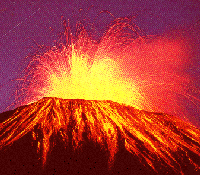
http://volcano.oregonstate.edu
What's new? Find out what the current eruptions are,
Volcano of the week: every week a new volcano is described.
Volcano starting points: your fun begins here. Explore the world of volcanoes.
http://www.geo.ntu.edu/volcanoes/
The Earths active volcanoes are listed by geographic regions. Each active volcano can be clicked on and various news articles on the eruptions are listed by dates. There is a lot of good information that could be graphed (even money damages - an interesting way to compare the effects of a volcano.)
http://pubs.usgs.gov/gip/volc/types.html
Learn about the four main types of volcanoes.
http://www.field-trips.org/tours/sci/volcano/_tourlaunch1.htm
Go on a trip to Hawaii.
Go to the top of the page.
Plate Tectonics
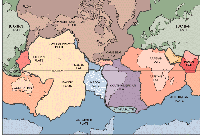
http://www.dinosauria.com/dml/maps.htm
See how the world has changed through the eras.
http://zebu.uoregon.edu/disted/ph123/pth.html
History of plate tectonics.
http://www.ceri.memphis.edu/public/
http://www.scotese.com/earth.htm
See how the continents of Earth have changed positions through time.
Earthquake myth and folklore.
http://www.EnchantedLearning.com/subjects/astronomy/planets/earth/continents.shtml
Good explanation of plate tectonics.
Go to the top of the page.
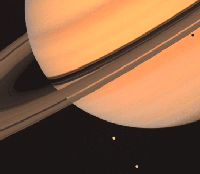
http://www.exploratorium.edu/ronh/solar_system/
This site allows you to build a solar system to scale
A good site for the solar system.
http://www.exploratorium.edu/ronh/weight/index.html
Learn what you would weigh on other solar systems.
http://antwrp.gsfc.nasa.gov/apod/astropix.html
Look at the astronomy picture of the day.
http://heasarc.gsfc.nasa.gov/docs/StarChild/StarChild.html
Easy reading for young students interested in the planets.
http://www.psi.edu/projects/planets/planets.html
Where did all the planets come from?
http://www.superstringtheory.com/cosmo/cosmo1.html
Learn how the universe began.
Go to the top of the page.

http://www.damtp.cam.ac.uk/user/gr/public/gal_home.html
Good pictures and explanations.
http://zebu.uoregon.edu/disted/ph123/galaxies.html
Scroll down to the simple explanations of each galaxy. This site also goes through the process of stars making elements.
Go to the top of the page.
http://www.jetpunk.com/tags.geography.php
Thank you, John, for suggesting this great challenge)
http://appliancehelp.com/resources/Simple-Machine-Lesson-Plans.aspx
Thank you Jackie for suggesting this page on simple machines)
http://www.chromebattery.com/battery-kids/
Thank you Shaina for this site on batter experiments)
http://www.mapmsg.com/games/statetris/
Statetris is an interesting game mixing aspects of the popular game 'Tetris' and geography.
Instead of positioning the typical Tetris blocks, you position states/countries at their proper location.
http://www.sheppardsoftware.com
Fun chemistry and geography work
http://micro.magnet.fsu.edu/primer/java/scienceopticsu/powersof10/index.html
Powers of 10. Thanks to Don Jennings of Moteaco.com for finding this wonderful site.
http://www.museum.state.il.us/exhibits/ice_ages/index.html
In honor of Koichi who asked "Why?" The answer to your question is here.
http://zebu.uoregon.edu/disted/ph123/images/earthstruc.gif
A picture of the Earth showing the various depths of the Earth's layers.
http://dmns.org/main/minisites/iceage/index.html>
Learn about the ice ages.
http://www.quia.com/custom/29gate.html
A matching game on the Earth's physical features.
http://www.quia.com/custom/407gate.html
A matching game on geography term.
http://www.quia.com/custom/512gate.html
A matching game on Earth's surface features.
http://ww2010.atmos.uiuc.edu/(Gh)/guides/mtr/hyd/home.rxml
The Water Cycle and more...
http://www.webelements.com/webelements/scholar/index.html
Explore the periodic table!
http://chemicalelements.com/index.html
Learn about the elements.
http://www.ps.uci.edu/~superk/significance.html
So, you wondered about neutrinos...
http://www.edheads.org/activities/simple-machines/index.htm
Fun activities about simple machines and surgery...
Go to the top of the page.
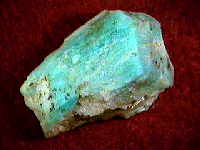
http://www.cotf.edu/ete/modules/msese/earthsysflr/rock.html
Simple rock cycle information
http://www.rocksandminerals.com/rockcycle.htm
A more detialed explanation of rocks, minerals and the Earth and how they all interact.
http://www.theimage.com/mineral/minerals1.html
Pictures and descriptions of minerals.
http://minerals.net/mineral/index.htm
Minerals and gems are classified and dxecribed.
Go to the top of the page.
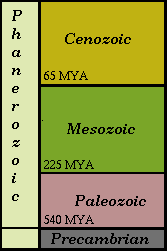
http://www.ucmp.berkeley.edu/help/timeform.html
WOW! This is just like the timeline - more information then there's time to learn. Lots of good information and pictures of the different periods of the Earths history. The pictures are slow to download so be patient. The links at the bottom go to other neat stuff. The Any Taxon link is great for phylum work. See where it takes you. The reading is not easy, but you can understand most of it.
http://www.talkorigins.org/origins/geo_timeline.html
This site has a wonderful evolutionary timeline.
http://www.ucmp.berkeley.edu/paleo/fossils/
So, you want to see what the Silurian Period was like? Go here.
Hear ye, hear ye. Tetrapods have landed. It's the Devonian Period.
http://www.lifethroughtime.com/
http://www.globalcommunity.org/wtt/walk_menu/index.html
Photo journeys of Earth's history.
Good information on North America.
Go to the top of the page.
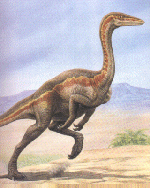
Learn everything about dinosaurs.
http://www.ucmp.berkeley.edu/diapsids/dinosaur.html
More about dinosaurs.
http://www.ZoomDinosaurs.com/subjects/dinosaurs/mesozoic/
The dinosaurs roamed the Earth in the Mesozoic Era.
Go to the top of the page.
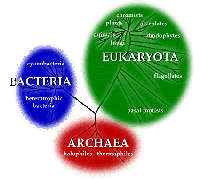
http://www.amnh.org/exhibitions/Fossil_Halls/cladistics.html
Learn what a cladogram is.
http://www.discoverlife.org/nh/
Good photos showing the diversity of life.
Go to the top of the page.
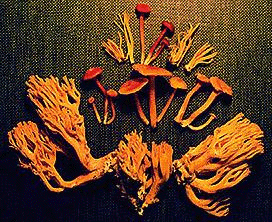
http://www.ucmp.berkeley.edu/fungi/fungisy.html
Neat fungi research.
http://herbarium.usu.edu/fungi/FunFacts/factindx1.htm
Great photos and descriptions.
Go to the top of the page.
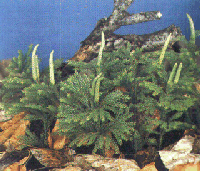
http://www.ucmp.berkeley.edu/plants/plantae.html
The history and classification of plants.
http://www.gardendigest.com/timegl.htm#Start
A history of the cultivation of plants.
http://share4.esd105.wednet.edu/kteske/gottier/index.htm
Learn about plant classification.
Go to the top of the page.
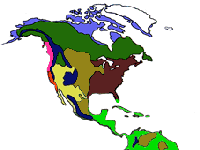
http://desertusa.com/life.html
Learn about the deserts of the American Southwest.
http://www.ucmp.berkeley.edu/glossary/gloss5/biome/
Learn about the biomes of our Earth
http://www.cotf.edu/ete/modules/msese/earthsysflr/biomes.html
Learn about the climates of biomes and how it affects the animal and plant life
Go to the top of the page.

http://home.freeuk.net/elloughton13/vikings.htm
Fun with vikings.
http://csis.pace.edu/grendel/projs3h/castles.htm
http://www.chronique.com/Kids/crusader.htm
Two great sites on medieval history.
http://www.pbs.org/empires/romans/index.html
Learn about the Roman empire.
http://www.time.gov/exhibits.html
A great page for the history of time, clocks and calendars.
http://memory.loc.gov/ammem/today
What happened in history today.
http://www.flagco.com/flags/worldflags/index.shtml?gclid=CNedxLyUs6oCFUID2godsHsMKw
The flags of every country are shown as well as facts about the country.
http://www3.kumc.edu/diversity/
http://the-north-pole.com/around/
Holidays for every month
Go to the top of the page.
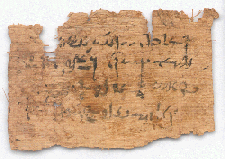
http://www.historian.net/hxwrite.htm
A good site to learn about how writing changed through time.
http://www.eyelid.co.uk/hiero1.htm
A Great Hieroglyphic translator. Translate your name or your message to egyptian hieroglyphs.
Go to the top of the page.
http://www.agnesscott.edu/lriddle/women/women.htm
Biographies of Women in Mathematics.
http://archives.math.utk.edu/topics/history.html
A very comprehensive site covering the history of mathematics.
Go to the top of the page.
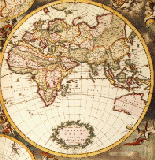
http://www.bbc.co.uk/history/interactive/animations/map_making/index.shtml
Interactive maps.
http://academic.emporia.edu/aberjame/map/h_map/h_map.htm
Explore ancients maps.
http://www.henry-davis.com/MAPS/AncientWebPages/Ancient1.html
More ancient maps.
Find out about the time zones of the USA
Go to the top of the page.
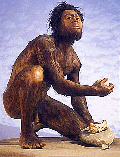
http://www.bbc.co.uk/science/cavemen/chronology/contentpage1.shtml
Learn about our own evolution.
http://www.culture.gouv.fr/culture/arcnat/lascaux/en/
Cave painting at its best!
http://www.mnh.si.edu/anthro/humanorigins/index.htm
Scroll to the bottom for a site map and have fun!
Go to the top of the page.
 Cartography
 History Book Club